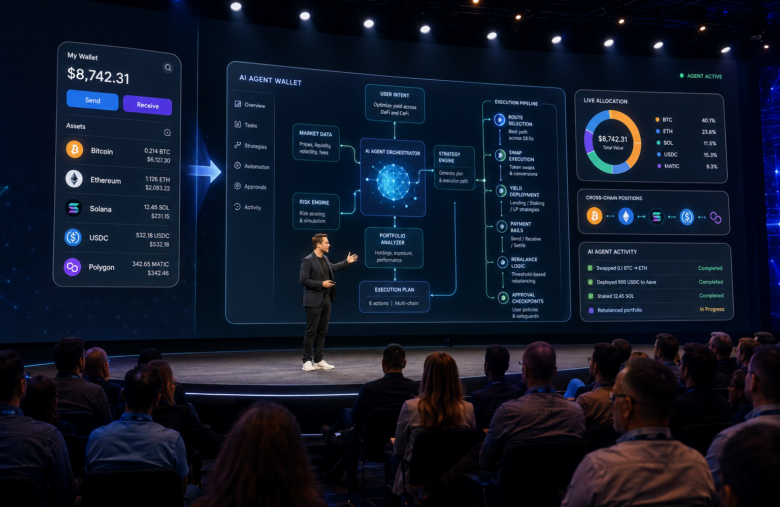
If you still think of a wallet as a place to store keys and click “send,” you are already behind where the industry is heading. The AI+crypto frontier is pushing wallets into a new role: not passive vaults, but active execution layers that can authorize machine actions under tightly defined constraints. That shift is subtle in product announcements, but profound in architecture.
Coinbase’s agentic wallet push put this trend into plain view by framing wallets as programmable interfaces for autonomous software, not just humans tapping mobile screens. In this model, the key challenge is not only custody. It is designing safe delegation: what an agent can do, under which conditions, with which spending limits, and with what audit trail when something goes wrong.
Industry conversations around AI-powered wallet behavior echo the same direction: give agents the rails to pay for APIs, execute recurring onchain actions, and coordinate transfers, while keeping the human operator in ultimate control. This is where crypto’s composability becomes more than a slogan. A wallet can be a policy engine layered on top of onchain primitives, with specific guardrails for time, amount, counterparty, and purpose.
The technical implication is that UX and security are converging. Historically, wallet UX optimized for fewer clicks; security teams optimized for fewer breaches. Agentic systems demand both simultaneously. If controls are too strict, agents become useless. If controls are too loose, agents become liabilities. The winners in this cycle will likely be teams that treat permissioning logic as a first-class product feature, not an afterthought bolted onto transaction signing.
So yes, this is still early. But the direction is clear: AI agents need native money movement, and crypto wallets are being rebuilt to provide it. The next competitive moat will not be who has the prettiest interface. It will be who can safely let autonomous systems do real work onchain without giving them enough rope to burn the user.